Cheloveinik
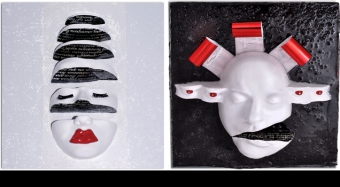
10.10.2014 - 10.01.2015Spbart.com gallery opens an awesome interactive exhibition by Natasha Van Budman entitled "Look Out". A collective portrait of contemporary Russian society, a dozen works are made with a rare assemblage technique that emerged in the early 20th Century and was used in the works of major artists from Rodchenko to Gormley. The project's author Natasha Van Budman explores the issues of tolerance in modern society. The artist tries to show a unified picture of the problems of human existence in each of the characters in the exhibition. The variety of represented objects allows the viewer to understand that tolerance to a different way of thinking and way of life is a prerequisite for the harmonious existence of man in the world today. We talked to the artist about her psycho-social project.
Spbart: "Look Out" features a collective portrait of contemporary Russian society. Which characteristics of this society have inspired you?
Natasha Van Budman: While working on "Look Out", I conducted my own research and tried to plunge into the characteristics and circumstances of lives of very different people living in Russia. I concluded that there is nothing more interesting and multifaceted than the human soul. And the more I learned the Russian people the more psycho-type of these people opened to me. They are very different from Western counterparts though sometimes even possess same name. The idea of the series was born when I started actively performing at theater, try on different characters. It was then that I wondered why in real life, people use masks? Series is finished and I got answers to these questions. By wearing a mask, a man does his existence in a society comfortable, but loses the uniqueness given by the Creator, the harmony, and enables society controls him.
Spbart: Why did you decide to use the technique of assemblage?
Natasha Van Budman: In my work, I show a unified picture of the problems of human existence in each of the characters. The complexity of assemblage technique is comparable to the main theme of the project. Audience is overdosed with visual information. We need strong images and three-dimensional effects at different levels. I invite the viewer to feel the atmosphere of <> and feel the unity of human nature in a variety of different psychological types. The three dimensional assemblage technique enables you to experience that.
Spbart: What are the advantages and disadvantages of being an artist in contemporary Russia?
Natasha Van Budman: The advantage of course is a wide range of technological opportunities, when I needed a molded plastic and silicone I easily found it. There are some disadvantages but eventually you can transform them into advantages. First of all the difficulties do not make me scared, I’m excited about them. Secondly, they impulse me for creativity - when I looked for space for my exhibition, I met with art critics and gallery owners unfamiliar with elementary history of art - is became a revelation for me. This is one of very interesting characters present in the modern Russian society, and it became a part of my exhibition.
Spbart: What is the name of your hero?
Natasha Van Budman: I adore people of whom history is often silent, or there is few information, but their contribution to world culture is very high. For example, such person was Dali’s woman - Gala. These are people who are able to multiply the potential of another person and be for him a small plant supplying creative electricity. And without Gala there would be no Dali.